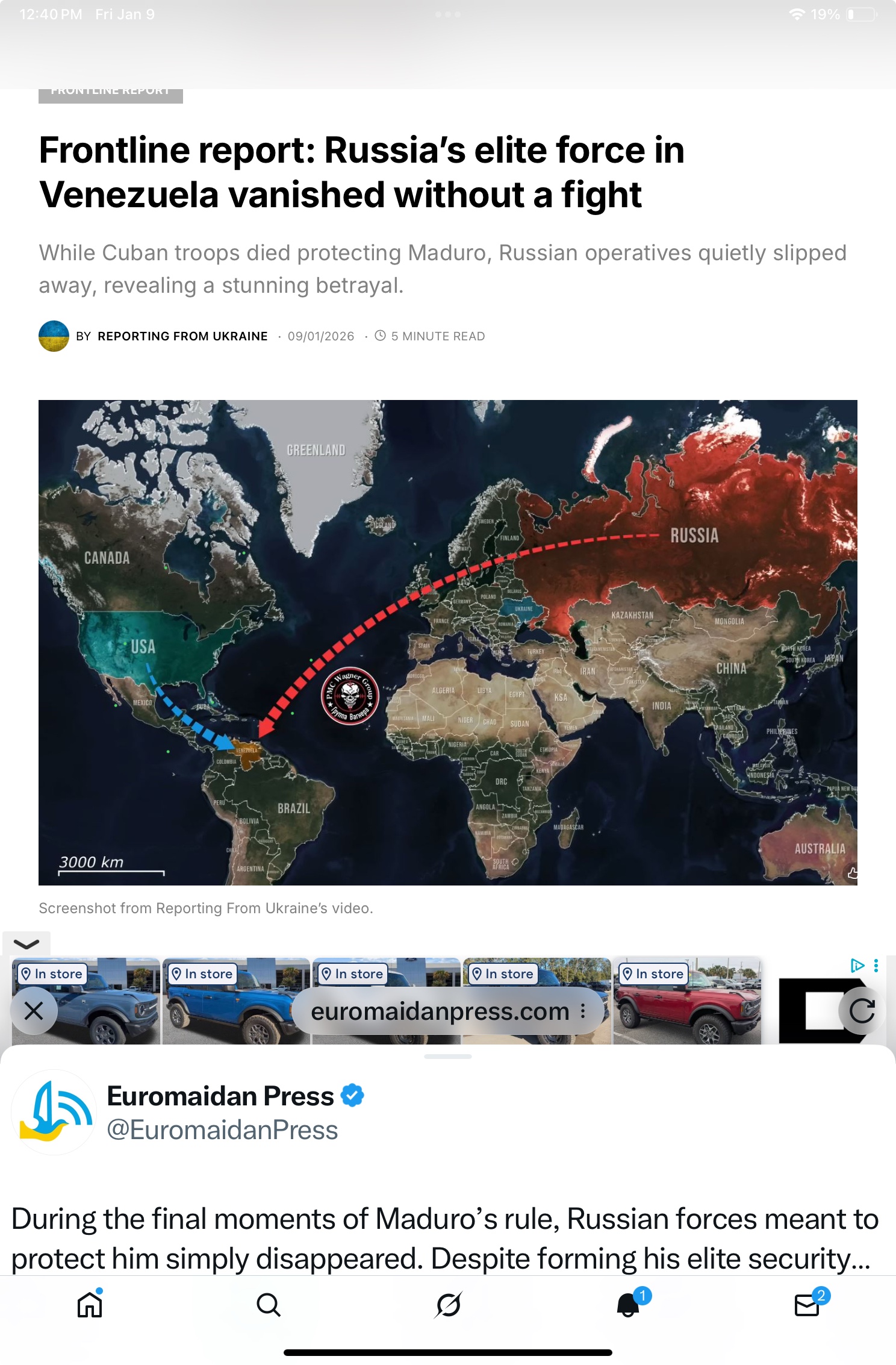
x.com/zmadon/status/2012603970464669913


VOTES IN FAVOR OF TRUMP
Trump appointees
Join me in trying to make sense of a complicated world.
January 2026
Wednesday 14 January 2026
A representative from Denmark and one from Greenland made statements in Washington, D.C. today. They noted that the discussions between them and Marco Rubio and the el Crapo J. D. Vance ended without agreement. It was a sad event to watch. Neither Vance nor Rubio stood with them. They were just left out there alone in front of some cheap steel-framed building to read their statements
The woman from Greenland had her brows so furrowed, there were deep lines on her forehead. The diplomat from Denmark had evidently been at the diplomatic game for a long time and even though he didn’t look happy, he maintained a stoic expression. You could tell it was taking a lot of energy out of him.
It is just all so absurd. The two representatives evidently had to assure the Americans that Chinese and Russian war ships were not cruising around right off Greenland’s shore. I’m sure the U.S. intelligence community had no idea that Trump’s accusation that this was going on was false. I mean, they would have told him, wouldn’t they?
Because of the greedy, grasping nature of the rest of us, the Arctic is warming at least twice as fast as the rest of the planet. This means that the Arctic is more accessible and also a more strategic target for graphite, zinc and rare earths (Sengupta, Somini, NYT, 1/14/26).
As a former Pentagon official said to the NYT: “His (Trump’s) fixation on Greenland is an admission that climate change is real. And, of course, “some of Mr. Trump’s allies have invested in mining interests in and around Greenland. Greenland, evidently populated with reasonable people has banned uranium mining because of the risk of environmental damage. The same considerations have prevented Greenland from granting oil exploration licenses (noting also “economic common sense) (Sengupta, 1/14/26).
NOTES ON GREENLAND (NYT, 1/14/26)
• Greenlanders have free health care, free education and a strong safety net.
• “Greenland still relies on hundreds of millions of dollars each year in Danish subsidies.”
• “Under a Cold War treaty, American forces already enjoy almost unfettered military access” to Greenland.
• Relations between officials in Greenland and Denmark are not always amicable. In one meeting recently a Greenlandic official “raised her voice and pounded the table, accusing her Danish colleagues of acting neocolonialist.” (NYT 1/14/26).
• Trump seems to feel that NATO should be the real estate agent helping him acquire Greenland. “NATO should be leading the way for us to get” Greenland, Trump commented on the 14, the day of the meeting. (NYT, 1/14/26)
• There is concern within NATO that if Trump were to invade Greenland, Russia might seize the opportunity to send forces into alliance territory (NYT, 1/14/26)
NOTES FROM THE NEWS (NYT 1/14/26)
• Trump cuts $2 billion in federal funding for mental health and substance abuse.
• Immigrant visa processing is to be halted for 75 countries.
Notes on the News: Georgia 2020 Election (Fausset, Richard and Danny Hakim, In Secret Testimony…” NYT, 1/13/26)
• In 2023 Fani T. Willis, the Fulton County District Attorney, brought a case against Trump and 18 allies on election interference charges. The case was dismissed in November.
• Evidence was presented before a special grand jury which recommended indicting more than twice as many Trump allies as Willis eventually charted.
• Quote from Lindsey Graham’s interview: “If you told him Martians came and stole votes, he’d be inclined to believe it.”
• Ralston, the Georgia House Speaker received a phone call from Trump urging him to call a special session of the state legislature to overturn Georgia’s election results.
• Kemp said that Trump had “urged him to convene a special legislative session, and to order an audit of ballot signatures.” Kemp reportedly said in his interview of Trump:”I repeatedly told him…what the law was here.”
QUOTES OF THE DAY
• Donald Trump: “My own mind. It’s the only thing that can stop me.” (NYT, 1/14/26)
• Jamelle Bouie: “Trump’s assertion of unlimited authority…is a total rejection of popular sovereignty and the logic of the Constitution.” (NYT, 1/14/26)
• Jamelle Bouie: “Trump does not see himself as a constitutional officer. His power, as he sees it, flows from his person – not the office and certainly ot the people, whose only role, in his view, is to legitimize his desires” (NYT, 1/14/26)
• Jamelle Bouie: “The American public…is left not with a president but with a man who imagines himself master and behaves like a tyrant.” (NYT, 1/14/26).
• Pipaluk Lynge, one of Greenland’s top officials: “We’re not going to sell our soul. We’re not stupid.” (NYT, 1/14/26)
• Donald Trump: We’re going to “do something on Greenland, whether they like it or not.” (NYT, 1/14/26).
• Greenlander: “We’ve never heard anyone talk like that about another country before.” (NYT, 1/14/26)
• “I think NATO is too important for the united States to throw it away.” (NYT, 1/14/26)
GOOD READS
Bouie, Jamelle (1/14/26) “This is Not how a Normal President Speaks.” New York Times.
Steele, Christopher (2023) “Unredacted: Russia, Trump, and the Battle for Democracy.”
Isikoff, Michael () “find Me the Votes.”
A Senate war powers resolution aimed at limiting President Trump’s authority to take further military action in Venezuela failed Wednesday, after two Republican senators — Senators Josh Hawley and Todd Young — withdrew their support. Vice President JD Vance cast the tie-breaking vote to dismiss the measure. Meanwhile, the U.S. completed its first sale of Venezuelan oil, valued at about $500 million. Semafor reports that the revenue from the oil sales is currently being held in bank accounts
— Read on www.democracynow.org/2026/1/15/headlines/senate_republicans_kill_war_powers_resolution_to_limit_trump_on_venezuela
Tragedy was the predictable outcome of a system built to prioritize intimidation over judgment, speed over restraint, and obedience over accountability
— Read on blogs.timesofisrael.com/a-neighbor-on-the-ground-renee-goods-death-by-design/
And this is the part we have to say plainly, even if it makes people uncomfortable. What happened in Minneapolis was not a tragic anomaly. It was the predictable outcome of a system built to prioritize intimidation over judgment, speed over restraint, and obedience over accountability. When an organization adopts Gestapo-like tactics, operates with insufficient training, deploys agents into civilian spaces as shock troops rather than peacekeepers, and cultivates a culture that treats communities as hostile territory, tragedy stops being accidental. It becomes inevitable. Not because any individual woke up intending to kill a neighbor, but because the system rewards speed, force, and compliance, and punishes hesitation, judgment, and restraint.
The subtext is unmistakable. Some deaths count less. Some lives are provisional. Some victims deserve suspicion more than sympathy. That is not moral clarity. It is moral rot. And when institutions rot this way, excuses start to align. Justifications repeat. Force finds its rhythm.

www.nytimes.com/2026/01/14/world/middleeast/iran-protests-soltani-execution-trump.html
Iran was expected to execute a protester on Wednesday for the first time during the current wave of antigovernment unrest, according to human rights groups and family members of the protester. President Trump has threatened “strong action” if Iran carries out any such death sentences.
Rights groups and relatives identified the protester as Erfan Soltani, 26, from an area west of the capital, Tehran. He was arrested on Jan. 8 and has been denied access to a lawyer or other means to mount a defense, according to the Norway-based Hengaw Organization for Human Rights.
A statement by the rights group said his family was also kept unaware of the judicial proceedings and was allowed only a brief, final visit before the scheduled execution, on Wednesday. On Tuesday, his family said he had never used violence and only sought basic freedoms for Iranians.
Since Dec. 28, Iran has been rocked by the largest protests in years against its authoritarian rulers, prompting Mr. Trump to say he would respond strongly.
www.nytimes.com/2026/01/11/us/politics/trumps-appeals-court-judges.html
President Trump has found a powerful but obscure bulwark in the appeals court judges he appointed during his first term. They have voted overwhelmingly in his favor when his administration’s actions have been challenged in court in his current term, a New York Times analysis of their 2025 records shows.
Time and again, appellate judges chosen by Mr. Trump in his first term reversed rulings made by district court judges in his second, clearing the way for his policies and gradually eroding a perception early last year that the legal system was thwarting his efforts to amass presidential power.
When Mr. Trump criticized a ruling from a so-called “Obama judge” in 2018, Chief Justice John G. Roberts Jr. responded that “we do not have Obama judges or Trump judges, Bush judges or Clinton judges.”
But the data suggests that in the 13 appellate courts, there is increasingly such a thing as a Trump judge. The president’s appointees voted to allow his policies to take effect 133 times and voted against them only 12 times. Ninety-two percent of their total votes were in favor of the administration. That figure far outstrips support for Mr. Trump’s agenda from appeals court judges appointed by other Republican presidents, and from Mr. Trump’s appointees to the district courts.
President Trump has found a powerful but obscure bulwark in the appeals court judges he appointed during his first term. They have voted overwhelmingly in his favor when his administration’s actions have been challenged in court in his current term, a New York Times analysis of their 2025 records shows.
Time and again, appellate judges chosen by Mr. Trump in his first term reversed rulings made by district court judges in his second, clearing the way for his policies and gradually eroding a perception early last year that the legal system was thwarting his efforts to amass presidential power.
When Mr. Trump criticized a ruling from a so-called “Obama judge” in 2018, Chief Justice John G. Roberts Jr. responded that “we do not have Obama judges or Trump judges, Bush judges or Clinton judges.”
But the data suggests that in the 13 appellate courts, there is increasingly such a thing as a Trump judge. The president’s appointees voted to allow his policies to take effect 133 times and voted against them only 12 times. Ninety-two percent of their total votes were in favor of the administration. That figure far outstrips support for Mr. Trump’s agenda from appeals court judges appointed by other Republican presidents, and from Mr. Trump’s appointees to the district courts.
President Trump has found a powerful but obscure bulwark in the appeals court judges he appointed during his first term. They have voted overwhelmingly in his favor when his administration’s actions have been challenged in court in his current term, a New York Times analysis of their 2025 records shows.
Time and again, appellate judges chosen by Mr. Trump in his first term reversed rulings made by district court judges in his second, clearing the way for his policies and gradually eroding a perception early last year that the legal system was thwarting his efforts to amass presidential power.
When Mr. Trump criticized a ruling from a so-called “Obama judge” in 2018, Chief Justice John G. Roberts Jr. responded that “we do not have Obama judges or Trump judges, Bush judges or Clinton judges.”
But the data suggests that in the 13 appellate courts, there is increasingly such a thing as a Trump judge. The president’s appointees voted to allow his policies to take effect 133 times and voted against them only 12 times. Ninety-two percent of their total votes were in favor of the administration. That figure far outstrips support for Mr. Trump’s agenda from appeals court judges appointed by other Republican presidents, and from Mr. Trump’s appointees to the district courts.
President Trump has found a powerful but obscure bulwark in the appeals court judges he appointed during his first term. They have voted overwhelmingly in his favor when his administration’s actions have been challenged in court in his current term, a New York Times analysis of their 2025 records shows.
Time and again, appellate judges chosen by Mr. Trump in his first term reversed rulings made by district court judges in his second, clearing the way for his policies and gradually eroding a perception early last year that the legal system was thwarting his efforts to amass presidential power.
When Mr. Trump criticized a ruling from a so-called “Obama judge” in 2018, Chief Justice John G. Roberts Jr. responded that “we do not have Obama judges or Trump judges, Bush judges or Clinton judges.”
But the data suggests that in the 13 appellate courts, there is increasingly such a thing as a Trump judge. The president’s appointees voted to allow his policies to take effect 133 times and voted against them only 12 times. Ninety-two percent of their total votes were in favor of the administration. That figure far outstrips support for Mr. Trump’s agenda from appeals court judges appointed by other Republican presidents, and from Mr. Trump’s appointees to the district courts
The book cover. Princeton University Press
Far-right activist Nick Fuentes leading a rally in Michigan in 2020. Nicole Hester/AP

The “Claremont-ers”:Intellectuals affiliated with the synonymous conservative think tank founded by the followers of Jewish-German philosopher Leo Strauss who advocate a radical recovery of American’s founding principles.
The Postliberals: Many of whom are Catholics seeking to demote democratic ideas in favor of the “common good,” and its smaller integralist wing that calls to end separation between church and state.
The National Conservatives: A big-tent movement promoting nationalism and a homogenous nation-state.
The hard right: A loose constellation of online agitators with PhDs who promote misogyny, race theory and aestheticized hyper-masculinity.