-
Christina Amanpour interviews author Michael Lewis May 6, 2021 about his new book “The Premonition.”
In his book, Michael Lewis followed three characters involved in the public health system and tells their stories. The stories carry lessons for pandemic response in the past and the future.
As Amanpour notes, Lewis had already written about the hollowing out of creative professionals in the ranks of government. This hollowing out left a bureaucracy afraid of creativity and afraid of risk. When COVID hit, the CDC which should have been the leader, was afraid to act.
As Ezra Klein noted in his article about Lewis’ book in the New York Times (May 2021), the CDC was “too passive, too unwilling to act on uncertain information, too afraid of making mistakes, too interested in its public image.”
According to Lewis, the hollowing out of the CDC, the loss of their reputation, happened long before Trump. I was interested to hear this since during the COVID crisis I kept wondering how Trump could eviscerate the CDC so rapidly. Turns out he didn’t.
According to Lewis, by 2012 the CDC had become an academic institution reluctant to take on any action aside from studying problems. It had, according to Lewis, become a “disease observation and reporting” institution, not a disease control center.
Lewis tells the stories of several people involved in the public health system and their experiences dealing with the CDC. One, Charity Dean, was a public health official on the ground, locally. When she tried to get assistance from the CDC for public health problems, she found none. In fact, she found active hostility. When she called on the CDC to help her they actually obstructed her investigations.
Lewis commented that if the three people whose stories he told were asked whether the CDC would act as the battlefield commander in the event of a pandemic, they would have answer no. The Centers for Disease Control had ceased to function to control disease.
It was obvious to some people, people who were actively trying to develop strategies for a future pandemic, that a battlefield commander was going to be needed. But, the CDC wasn’t listening.
As Lewis tells tells the story, after 9/11 and Katrina, George Bush was primed to be concerned about any unexpected threat. Sometime in 2005, he was handed the book “The Great Influenza.” He supposedly read it and asked about the plan for dealing with a future pandemic. The answer was that there wasn’t any.
Surprisingly, the Bush administration acted quickly and within weeks had Congress appropriate money to study the issue and devise a strategy. Lewis notes how this back story illustrates just what can be done quickly when the President focuses on an issue and decides to get something done.
And, also surprisingly, the individuals brought in from various federal agencies were nominated because of their reputation for creative thinking. That in-and-of itself is extraordinary. In a country that spends untold amounts of money creating commissions and investigations filled with dignitaries and political donors, this body was staffed by people who were creative. Go figure.
These folks Bush appointed to the commission, created a testing, tracking and social distancing strategy and convinced the rest of the world that it could be effective. This strategy was designed to decrease mortality during the period between the onset of a pandemic and the development of vaccines.
The kicker was that after convincing a skeptical world that this public health strategy could work, the country that developed it failed to adequately put it into effect when a read pandemic occurred.
Lewis noted that this was because the strategy was widely considered to be a theoretical idea not an implementable public health measure. Similarly, a pandemic was considered to be a theoretical threat, not a real possibility.
But, people on the ground, people like Charity Dean, one of the people in Lewis’ book, were looking at factors like the increasing worldwide transmission of viruses from animals to humans. What they were looking at wasn’t a theoretical possibility. When they looked at the evidence, the outbreak of a dangerous pandemic was a matter of when not if.
But, as Charity Dean told Lewis, people like her felt like Moses, building the ark. Everyone around them accused them of lunacy. So, there were people who knew a dangerous pandemic was coming. When Trump went on national TV and claimed that the COVID virus outbreak was a total shock to the world, he was (as usual) lying.
By 2011 people like Charity Dean, people on the local level of public health, knew not only that a pandemic was coming, but that the country was unprepared. The population, however, (as usual) was being told that we were the most prepared country in the world.
Studies ranking preparedness, listed the U.K. an the U.S. as the most prepared countries in the world. They were wrong. They made people feel good. They made people complacent, but they were wrong.
As Lewis noted, the U.S. with 4% of population would up with 20% of the deaths. Somehow, sometime, Americans are going to have to stop creating and repeating and believing their own propaganda.
Crisis response is not about having the most resources or the most labs or the most prestigious boards at the CDC. Lewis detailed some of the problems that are part of the structure of the society, features that make crisis response (whether it’s to a war or a pandemic) almost impossible.
Lewis and doctors at the WHO, talked about the endemic fear of failure. As one of the doctors at the WHO put it, in March of 2020, fear of failure, fear of making a mistake has become paralyzing. “If you need to be right before you move, you will never win.”
Lewis noted that the culture has been primed to punish viciously crimes of commission, but to forget crimes of omission. It doesn’t take much to predict which crimes will be the most prevalent.
Many of the researchers who understood and warned about the coming pandemic believe that this is not the serious pandemic they are concerned about. They believe that this is only a dry run. The real pandemic has yet to happen. We all need to put that in our pipes and smoke.
TOMORROW: How the For-Profit Health Care System Crippled the pandemic Response.
-
10 May 2021
The New York Times (Marshal, 5/9/21) reported an increasing number of potentially fatal fungal infections affecting people who have COVID or who have recently recovered from COVID. The condition affects people who have compromised immune systems especially those with diabetes.
This is a respiratory mold that was present in India before the pandemic. It erodes the facial structure and harms the brain. Doctors posit that the increase in the incidence could be from self medicating, or the widespread use of steroids to treat the virus.
Marshal (5/9/21) “A potentially fatal fungal…” New York Times
After reporters in India attempted to alert the world to the severity of the problems in the country experiencing a devastating second wave of COVID, right-wing social media started attacking the journalists. In what has been called “an orchestrated move” the right is trying to discredit journalists, especially those wiring for foreign publications like the Washington Post.
They have been slammed as “vultures” for posting photographs and video of crematoriums. Indian journalist Barkha Dutt was criticized as taking “a macabre ghoulish delight at our misery.” She was called a disgrace to India. Dutt has said in interviews that many journalists are being asked not to share photographs of the situation in India on the ground.
Sources
Article: The News Minute
-

In the past two days I have listened to three interviews with Indian journalist Barkha Dutt about the stunning second wave of COVID deaths in India. Dutt lost her own father to COVID within the past week. She comes from what she describes as a privileged family in India, but even so, she was not able to get the medical attention that could have kept her father alive. The desperation in her reporting and in her voice are inescapable.
After it became apparent that a second wave of COVID was out of control in India, a number of journalists posted photographs of vastly overburdened crematoriums operating all over the country. There was also video footage of hospitals that are so over run patients are laying on the ground, or on flattened paper boxes with IV feeds hanging from the limbs of trees. Family members are desperately running from hospital to hospital seeking medical attention for loved ones, and individually searching for oxygen and taking it to those lucky enough to be in hospitals.
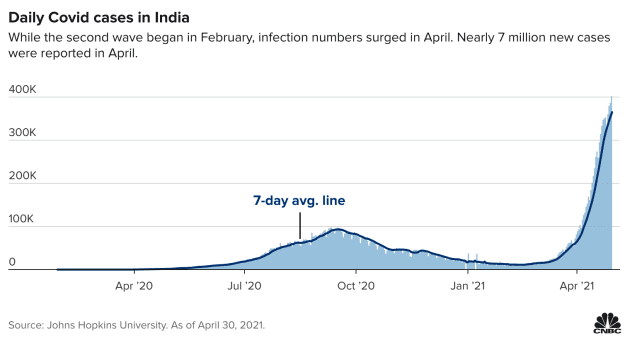
According to Dutta, India was incredibly complacent after the first wave of COVID. Most people thought the worst was behind them. The Indian government failed to buy adequate supplies of vaccines to cope with a possible second wave, rejected the idea of buying vaccines that weren’t completely made in India and even gave vaccine away after the first wave. Politicians continued to have enormous rallies without any social distancing or masking and the government allowed masses to gather for religious services.
Now, a second wave has hit India and even the official statistics of deaths are stunning. And, as Dutt reports, the official statistics, alarming as they are, are grossly underreporting the number of deaths. Dutt has talked to crematorium workers who report burning over 120 bodies a day. This is one crematorium in one location. Government statistics for that region, report something like 47 deaths for the entire city.
Dutt has said that she can’t even estimate how extensive the underreporting is. She said that she has seen instances where there is as much as a four-fold difference between the official statistics and those she estimates for a city.
To add to the problem, some testing facilities have been asked to decrease the amount of testing so that there will not be so many cases reported. This is reminiscent of actions taken by the Trump administration when COVID case counts became politically embarrassing.
Dutt argues that the Indian government was outrageously complacent and did not adequately prepare for the possibility of a second wave of COVID. She also reports that people in India while initially forgiving of the mistakes of the government, are now angry.
Some people are blaming health care workers for the lack of vaccines and infrastructure, but in fact, it is the fault of the government. Citizens, she says, have been left to fend for themselves. Whether you survive this pandemic depends on who you know and how strong you are. It is survival of the richest and the most connected. People feel that they are out there all alone, she says. There is no state apparatus to turn to for help at the hospitals or the crematoriums. It is just every person on their own fighting for resources. You can hear the fear and desperation and anger in her voice.
This is what the social configuration looks like when the state breaks down in a complex society. This is exactly what the Republicans have in mind for this country. They have worked for decades to destroy the faith people had in the government. They have worked tirelessly to block any policy that would have allowed government to improve their lives of the citizenry. They have blocked any policies which would have even allowed the government to function. Republicans are against effective programs to deal with COVID because successful state intervention in a crisis might have caused people to start understanding and valuing the role of government in a complex society. An effective government response to COVID might cause people to question whether the state is the enemy.
Numerous corporate journalists (who are like parrots) are now having a field day talking about how the Republicans have ceased to be ideological. Nothing could be further from the truth. They have been and are now conducting an ideological fight for a world where life is each against all, where the wealthy and the powerful can secure access to health and clean food and clean water and the rest of us fight it out on the street as did Dutt’s family when they went to have her father cremated.
This is the world Republicans are ushering in. The reality is staring us in the face every day, with every news report, but the reality is so disturbing Americans cannot and will not look at it. They would prefer to watch corporate news hosts make celebrities out of the hundreds of thousands of people who needlessly died because of a refusal to allow the government to act. They would rather watch hosts quote rap lyrics as if they were great literature, follow the soap opera of the royal family, or interview each other about their books (which all say that the institutions are holding and everything’s fine). The American people would, in other words, prefer to do anything, anything but look at the stark reality of the world the Republicans are preparing us for.
And, we should remember that many of these Republicans have no investment in this world. They truly believe that this is the “end times,” and that in a very short time they are going to be leaving the rest of us behind while they ascend to heaven. So, far from being free of ideology, they have the most destructive ideology on the planet. They believe that the worse things get the better because that brings us nearer to the end of the world.
If you want to know what that world is going to look like, just take a look close look at India.
Dutt was interviewed on Christine Amanpour’s nightly news program and by Ian Bremmer on his podcast, Gzero World (5/8/21)
-
BBC:
https://www.bbc.com/news/world-latin-america-56983865
• The UN human rights office has accused Colombia’s security forces of using excessive force against protesters
• They are particularly concerned about events in Cali on Monday, where police fired on protesters.
• The government had argued that new taxes were necessary to mitigate Colombia’s economic crisis.
• The “reform” would have lowered the threshold at which salaries are taxed.
• More than 800 people are reported to have been injured in clashes between police and protesters.
• The response is predictable. Officials claim that the police themselves were attacked and that the police were dealing with “criminal elements.”
Associated Press
• The Associated press is reporting 26 people killed in protests in Colombia in recent weeks.
• The police are arguing that rebel groups have infiltrated the protests and drug trafficking enterprises are funding the protests.
• Police are heavily armed from years of dealing with drug trafficking.
Scotsman (5/7/21)
• The Scotsman is reporting as many as 37 people killed in clashes with police in Colombia.
• The protests are also about the privatization of health care, something that wasn’t mentioned in the corporate media.
• The Scotsman is also reporting 89 people missing.
• Colombia is experiencing the third highest rate of covid deaths in Latin America.
-

Colombia
• There are violent riots in Colombia brought about partly because of a proposed tax hike.
• It is estimated that 45% of the people in the country are living in poverty. There are high levels of unemployment.
• Due to the protests, the proposed tax hike has been withdrawn, but that hasn’t been enough to calm the situation where other grievances are fueling the protests.
• Political parties have been weakened in Colombia and in effect, ceased to function. The streets are the only viable political vehicle.
• “Latin America is going through hell.” Says Moises Naim, Carnegie Endowment for International Peace.
• The consequences of the pandemic have been dire. Latin America has 8% of the world’s population, but 35% of total Covid deaths.
• Protest in Latin America is met with arguments of 1) conspiracy – protest is the effect of outside forces (the old “outside agitator” argument; 2) copy cats – this is people copying Hong Kong and other protests; 3) combustion – people are fed up because of other issues and they take to the streets.
• There is a covid-enhanced erosion of democratic forms. There is a concern about decreasing rather than increasing democracy in Latin America.
See the interview with Moises Naim on Amanpour and Company.
-

Podcast “On Topic”
Matt Gaetz (April 17, 2021)
Notes on Interview with Renato Mariotti
- Gaetz is certainly a subject of the investigation.
- A target means that the prosecutor intends to indict.
- Being a subject is not something you should feel good about. It means they’re trying to develop enough information to charge you.
- The defense attorney can ask if his/her client is a subject or a target.
- Sex trafficking statute. Drugs potentially can go to the coercion part of the law.
- Drugs are at the very least a thing of value you can be exchanging for sex.
- Mariotti is talking about the decisions that go into charging, whether there is enough evidence to win in court on a specific count.
- Mariotti maintains that he would want to have the 17-year-old count. Juries will look at the defendant as such a sleaze they won’t be able to think of anything else.
- The Mann Act is a “strange act.” Enacted over a century ago. Weird language in it.
- It had been used to prosecute people for sex among adults. People questioned the use. Mariotti maintains that it is not a normal act for the federal government to charge under.
- When there are federal Mann act cases, they usually involve child sex trafficking.
- My note: Why was Bill Barr so determined to stay away from this case and Matt Gaetz? Why didn’t he quash the case?
- There is the speculation that this case is larger than the underage girl question?
- Mariotti argues that he would want a slam dunk charge like identity fraud or bank fraud. Then, he would introduce the other sex acts as context. The idea is to convict Gaetz on the fraud charges (the “slam-dunk”) and then tell the judge that the fraud was committed in the context of the sexual behavior which the judge would consider in sentencing.
- My note: I don’t really understand this but it sounds sleazy as hell.
- My note: Why is Mariotti even talking about Gaetz being charged for political reasons? Is he arguing that they should charge the “slam-dunk” instead of the sex charges because it can be argued that the sex charges are politically motivated? Why? What difference does that even make? Why are people so afraid of what some Republican might say about criminal behavior? If Gaetz has violated the law, he has violated the law.
- My note: Mariotti is maintaining that one of the considerations in charging is: “How will this cause people to view the Justice Department differently?” So, what’s Mariotti’s actually saying is that the Justice Department itself is making political decisions (the politics of their own image) in charging.
- My note: This is the type of attitude that led Comey to make some of the decisions he made that were so disastrous for the Democrats. He made decisions partly on the basis of what he thought was good for the Justice Department and its image, not on what DOJ policy was and had been when he announced they were not charging Clinton, but probably should have.
- My Note: Gaetz was showing photographs of naked women to other men on the floor of the House and bragging that they were his conquests. I would like to know who he showed these photographs to and why they didn’t report him and have him censured? Who were they?
- My Note: Matt Gaetz, a Republican, and his behavior with underage girls speaks to the repeated projection by the Republican party. They have spent years accusing Democrats of running a pedophile ring. Now that they have a pedophile in their midst and they are fine with it. It’s all projection. So, I keep thinking about the “baby eating” charge.
- The interviewer asks, as a prosecutor would you bring in the fact that Gaetz showed these photos on the House floor? Mariotti says that if he were the judge he would not allow this evidence in because it would be too prejudicial. My note: Jesus Christ.
- Mariotti argues that it would be too prejudicial because “Jurors would judge him (Gaetz).” My note: Well, hell yeah. Quite rightly.
- Mariotti is talking about “streamlining” cases, what prosecutors do to “streamline” cases. My note: this is part of what’s wrong with the system.
- My note: In what universe is Gaetz’s showing nude photos of women on the floor of the House not evidence of a pattern of exploitive behavior towards women?
- Gaetz has chosen Mark Mukasey as his attorney. Mukasey’s father was at the Justice Department after Alberto Gonzalez. Mukasey’s a very good trial lawyer, according to Mariotti. He is very closely tied to Giuliani. Perhaps also representing the Trump Organization.
- My note: So now we know that Mukasey is part of the club.
- Gaetz still thinks he’s living in a world where Trump is president and can shield him.
- My note: these men wouldn’t be behaving like this, like they were above the law, if they hadn’t been for their entire lives. The world Mariotti lives in has shielded these elite criminals for decades.
-

CORPORATE NEWS IS NOT WORTH YOUR TIME
Former federal prosecutor Renato Mariotti talks about the possible prosecution of Matt Gaetz.
Notes on the Podcast
- Gaetz has finally hired an attorney and stopped running his mouth so publicy.
- Gaetz is trying to act like Trump in response to the investigation. The big difference is that Trump controlled the Justice Department, Gaeta does not.
- There is no accountability. We are still waiting for Trump to be indicted.
- Barr did fantastic job misleading the pubic about Trump’s collusion with the Russians.
- Gaetz thinks he can talk his way out of this.
- Gaetz’s girlfriend is the daughter of a big donor.
- Greenberg was the tax collector in Seminole County. He created a website slandering his political opposition as a pedophile.
- This person, went to authorities which led to an investigation of Greenberg.
- The investigation uncovered evidence of an identity theft scheme, making drivers licenses for women he is meeting on a Sugar Daddy website.
- Then, the investigation led to uncovering his interactions with an underage girl who had been interacting with Matt Gaetz.
- Politico reported that a few days before Greenberg was indicted, he texted all his buddies that they had better lawyer up. This text provided the feds a list of witnesses.
- They don’t need to prove Gaetz knew her age.
- There’s the sex trafficking statute (Commercial Sex Act) they can prosecute him under. This involves transporting underage person for commercial sex.
- They would argue that this wasn’t commercial sex.
- Gaeta has a very good lawyer.
- Gaetz is sending payments to Greenberg and Greenberg is distributing the money. Greenberg can testify about the purpose of the payments.
- Greenberg can tell the story of the criminal activity.
-

Dereck Chauvin put his knee on the neck of George Floyd, stared into the camera and dared us to do anything about it.
Donald Trump did exactly what Chauvin did – he put his knee on the neck of democracy, decency, legality. He stared into the camera and dared us to do anything about it.
Putin has done exactly what Chauvin did – he has put his knee on the neck of Navalny, stared into the camera and dared us to do anything about it.
These are lessons, authoritarian lessons. They are demonstrating to us that that they can do whatever they want. They can even murder one of us right in front of our very eyes and we can’t do a damn thing about it.
We have won tonight, in the Chauvin case. We have won because of the mobilization of millions of people putting pressure on the system to live up to its ideals. We have won because of the courage and discipline of a group of witnesses. We have won and we can win again.
We must stand together and stand up to the boot of authoritarian rule on our necks. We stopped them with the Chauvin verdict. That’s why the legal system avoids jury trials if at all possible, especially for powerful defendants. We can, and we must stop them again. We must demand that the participants in the corrupt crime spree that was the Trump administration are held to account. We must demand that dangerous men like Putin and the oligarchs that surround him are held to account.
If we do not see, truly see that these actions are preparations for authoritarianism, they will come back for us. They are obviously not phased in the least by the electoral defeat in 2020. The tidal wave of voter suppression being orchestrated by the Republicans is just another way to take power because they cannot win it legitimately. It is their way back in power. We must take them seriously or we will find ourselves in 2022 and 2024 with another authoritarian take-over of the governmental process. If we flirt with that possibility, we may never recover.
That look you saw on Chavin’s face when he was kneeling there, crushing the life out of a man, is the same look you would see on the face of Bill Barr, Donald Trump, Jared Kushner, Roger Stone, Steve Bannon, Pompeo, Pence, Steven Miller, Manafort and many others while they crushed the life out of anyone who opposed them if they thought for one minute they could get away with it. If we let them get away with it, they will crush the life out of democracy and our lives will be unalterably changed. If we don’t take them seriously, if we don’t fight them we will find ourselves living under that knee being given the same compassion and respect Dereck Chavin gave George Floyd.
-
News Roundup

Police
- On the internet: Video after video of police officers behaving abusively, escalating situations, cursing at people, threatening them, intimidating them, killing them, all over the country. CNN has an expert on to explain that our brains work differently when we’re under stress.
- The “stress professor” and the Vanderbilt guy both agreed that we need more training for police.
- I’ve been involved in criminology in one way or another for fifty years. I did research on female police partners and male use of deadly force in the 70s. Training is not the problem. Minneapolis, for example, spent a small fortune on training.
- Police culture will win out over all the training and policy in the world.
- If you look at the Derek Chauvin case as an example, Chauvin didn’t take the stand because basically his defense is that he didn’t do anything wrong and that he would do it again if he had the chance.
Authoritarians
- It appears that Alexander Navalny is dangerously close to dying. In the past, he told colleagues he couldn’t understand people using hunger strikes to advance their cases. It seemed, to him, merely a way to hand the state a tool. But, evidently the situation for him in prison was so bad, he resorted to using his own body as a tool to try to get help. It’s unlikely to work. The world stands by and watches.
- Gary Kasperov, former Russian chess player and current activist, pointed out on Twitter that the West continues to deal with Putin as if he were some quasi-democratic head of state. Kasperov noted that Biden’s decision to turn around a ship to try to appease Putin was the wrong tactic. Autocrats, kleptocrats, authoritarians view offers of compromise as weakness.
- Biden deals with Putin the way the Democrats deal with the Republicans. When will they learn that authoritarians cannot be compromised with or appealed to?
Corporate News
- Joe Scarborough, who helped elect Trump, is now back to his rabid Republican heckling. It is difficult for me to understand how anybody could think that Scarborough was an ally. He and the dreadful Mika were up Trump’s ass until Trump threatened to reveal their adulterous affair. People need to remember we have Mika on tape asking Trump’s permission to ask him a “hard” question. Morning Joe as outlived its usefulness if it ever had any. It belongs in the Chris Matthews trash bag of programming. MSNBC needs to do better.
- While I’m on MSNBC, the nightly news programs continue to use Jason “island of misfit black girls” Johnson as a commentator. He lost his job at the Root for his nasty, racist comment about the women who worked for Bernie Sanders, and MSNBC punished him with a few weeks off air. But, he’s back now with a vengeance. Joy Reid loves him because she actively worked to destroy Sanders’ campaign. The lesson here? You can say anything and get away with it if it’s about Bernie Sanders or his campaign.
Cats
- The new feral cat we are socializing woke me up at 3:30 in the morning because his food bowls were empty. I’m wide awake, but he’s back asleep, stretched out at the foot of the bed on a quilt. They learn so quickly. Cats are the masters of psychological manipulation. His name is Oliver Wendell Holmes.
-

If you don’t do anything else today, read this article about the legal underpinnings of the Chauvin trial.
https://www.thenation.com/article/society/chauvin-supreme-court/
-

Author of “Deadly Monopolies,” “Medical Apartheid,” and “Carte Blanche.”
Interview on CSPAN
https://www.c-span.org/video/?510051-1/depth-harriet-washington
-

It has been days since I have watched corporate TV news. I have been reading, writing, painting and binge-watching Dickens, Trollope, and Austen on Amazon Prime.
Every time I turn on the corporate news I find CNN hosts interviewing other CNN hosts about their new books. On MSNBC, I find people like Jason “Island of misfit black girls” Johnson, pontificating and acting like he’s something other than a vicious attack dog there to repeatedly blame the progressives in the Democratic Party for all the failures of the party establishment.
Morning Joe has turned into a prayer meeting with Joe Scarborough spending whole segments lecturing viewers on what a “true Christian” is. This is the news? Mika Brzezinski relentlessly promotes her “know your worth” marketing/money making strategy. She actually seems to think that people are going to believe this from a woman who “knew her worth” to such an extent she had an adulterous affair and then married her boss. She defers to him, babies him, allows herself to be regularly demeaned, interrupted and ridiculed by him. This is women knowing their worth.
In the afternoons, former Senator Claire MacCaskill has taken obsequious behavior to new heights, fawning over Nicolle Wallace at every turn, baking cakes for Wallace and lighting candles on the cake while lauding Wallace’s journalism. This is the news?
MacCaskill does this while the other members of the panel (including the other prime ass-kisser, Jason Johnson) clap their hands like school children. It is just nauseating.
There is no, no international news anymore on either CNN or MSNBC. The amount of information being communicated is almost nil. It’s like a televised circle-jerk, reporters interviewing other reporters, promoting each other’s books or (worse still) interviewing members of Congress, as if any member of congress is going to say anything either interesting or informative. There are only a handful of people in the entire Congress who say ANYTHING that is not a collection of focus-group tested nonsense.
The corporate media is, in short, like a toy my friend told me she bought her grandson a couple of years ago. I couldn’t even grasp what she was talking about as she described this gadget. It was a mechanical thing that had no purpose except to move. It was called a “fidget spinner.” The corporate news media is an intellectual fidget spinner – words and words and words and interview after interview after interview filling up space, for no reason except to make money for somebody and create the impression that things are under control. As Scarborough says the “institutions are holding.”
Meanwhile, the institutions are not holding. The criminal enterprise that was the Trump administration has gone without accountability or punishment, and will continue to do so. The legal system works to prosecute, hold accountable, and punish only the poor. We are repeatedly treated to an orgy of spectacle creating the impression that the powerful will be held accountable only to watch the whole sorry exercise collapse.
The Supreme Court which has sold democracy down the tubes with decisions such as Citizens’ United, is poised to further structure the legal system to favor the wealthy and powerful. The Congress is afraid of its shadow. If the Biden administration does not do away with the filibuster, alter the Supreme Court, fight for ordinary Americans, and ensure election fairness and security, the Trump/McConnell crime family will be back in power partially in two years, and totally in four.
All you have to do it look at the flood of voter suppression laws that have been passed in Georgia and other states to see that Republicans are going to make sure that the Democrats lose control of the Congress in 2022 and the presidency in 2024. They are circling like sharks. All four years of Trump did for them was to give them the smell of blood and demonstrate how easily they could turn this into an authoritarian Christian nationalist state.
Meanwhile, Ari Melber makes jokes, quotes banal rap lyrics (of sexist rap stars) like they were great literature and/or philosophy and interviews celebrities, barely keeping himself from peeing his pants with glee at his proximity to fame. It is all just really disgusting.
And, then there’s today. A 21-year-old man has murdered eight women and was on his way to murder more. But, as the Georgia Sheriff’s office spokesman said, he “had a bad day.” There are so many things wrong with this story and the coverage of it and the people involved, I don’t know where to begin.
I feel like my mother when she first started watching the O.J. Simpson trial. She watched for a couple of hours. “What do you think?” I said. “I think they should all be put in prison now,” she replied getting up in disgust to go and read. “Who?” I asked. “All of them.” She said. “Simpson, the judge, the prosecutors, the defense attorneys, the reporters, all of them.” She was, of course, right.
That’s precisely what I feel about everybody involved in this murder case in Atlanta.
The Georgia Sheriff and CNN are talking about “sex addiction” as if sex addiction was something real. Law enforcement, politicians and the corporate media are actually mouthing the ludicrous sex equivalent of the “Twinkie Defense” for this Long guy. The Cherokee Sheriff’s office guy, Baker, found it his responsibility to provide an excuse for a man who walked into businesses that employ women (at starvation wages) to cater to the perverted pleasures of men and murder them. What is this Baker, Long’s defense attorney? Official law enforcement provides a narrative for the future jury pool excusing this man because of his “sex addiction.”
“Sex addiction?” There is no such thing as a sex addiction. It’s a fake con devised by the rehabilitation industry to make money. No serious person would even allow those two words together to come out of their mouth. A male reporter on CNN said that the young man “had issues.” ISSUES?////// ISSUES?????????
He hates women, that’s the issue, he hates and despises women and has racist exploitive sexual fantasies about them that he felt entitled to act out. It has nothing to do with addiction. Long is not mentally ill, that we know of. He is just the same kind of oppressive, abusive, exploitive, violent bastard that this culture turns out by the millions. He’s just like Donald Trump, Jeffrey Epstein, that old man who used to be a comedian who doped and then raped women (I’m 70. I can’t remember his f…ing name), Weinstein, Cuomo, and God knows how many more.
But, we can’t talk about that. We can’t talk about a culture that makes the hatred of women fundamental, trades in the commodification of women’s bodies at every turn, provides a market for sexual perversion of every sort and then blames the impoverished women who are forced to participate in it for their own destruction at the hands of the very men they are forced to service.
This guy “had a bad day.” That’s what Baker, the Sheriff’s Office guy, said. He had a “bad day” and “issues” and “a sexual addiction.” No, the women who were killed and their families had a bad day, a tragic day. This guy acted out his violent racist sexual perversions, violent sexual perversions that are fed every day by the media and the entertainment industry and politics.
-
Subscribe
Subscribed
Have a WordPress.com account? Log in now.

